
Why We Chose Mistral Large for Code Reviews
Automated code reviews have become a necessity but they are very difficult to get right.
What do we want from automated code reviews?
- Automated code reviews for straightforward PRs, and escalation to a human when necessary
- Code reviews that improve the code quality by catching issues that humans frequently don’t (and we will see examples of that) but without drowning humans (or other agents) in false positives
- A setup that is fast and cheap, of course
- …and a system that we can adapt to use different models, as the best options considering quality, speed and cost change frequently
We went looking for a setup we could try on our own code. We had two open-source projects, years of pull requests and, conveniently enough, a supply of bugs we had written ourselves.
We found a setup we’re happy to put into production. Our pick is Alibaba Open Code Review (OCR) with Mistral Large 4. At OCR’s lowest effort setting it caught four of the five historical bugs we gave it, and a review usually came back in a few minutes. We added a rule about where to look for tests and a small script that tells CI when a person needs to take a look. We’ve already run it on a live Starlasu pull request.
Context: Software Factories on the horizon?
Large language models are changing the way we write software, and I have the temptation to go to the whiteboard and imagine the most glorious new way to do software development, building our own flavor of a software factory.
However, scars tell me that the “blank slate” approach just does not work. When processes need to change one needs to do things gradually. You change one piece, you look at what happens, you adapt and only then you move to the next piece. The big bang approach gives you half a day of ego boost but then fails at adoption time, either because you fail to consider some aspects or because humans fail to adapt. Incremental wins the race here.
So where are we with our software development process?
Let’s start by confessing that we are not living in a land of milk and honey as some people claim to be experiencing on LinkedIn. Here in the real world what has already changed for us is that we work with Claude Code or Codex, opening a session and working together with the agent. It works well, and it means that a lot more code gets written in a day than it used to.
Which is good, but that moves the bottleneck somewhere else, and in our case it moved to code review. If the amount of code grows the way it is growing, we cannot keep reviewing all of it by hand, and pretending we can just means that reviews become shallower without anybody saying so. I can type “LGTM” pretty fast now, but it is demeaning, and I die a little bit inside as a professional each time. The alternative of spending all day doing code reviews does not feel tempting either.
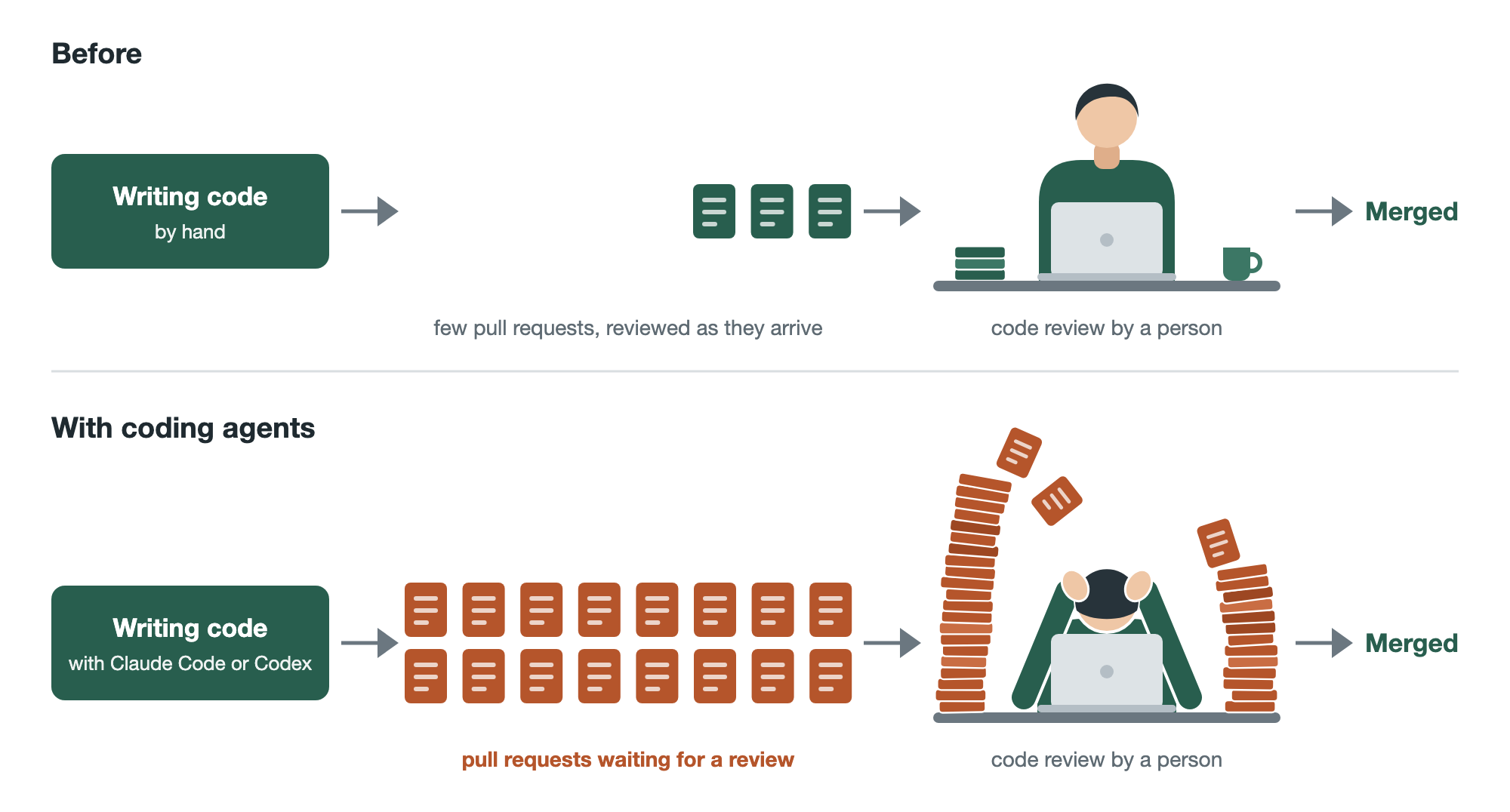
So at this stage what needs to be fixed is code reviews.
At Strumenta we have already built our own system for code reviews, which we call Olaf. Before investing more in it we decided to look seriously at what already exists as open-source. This is what we set out to do in this article.
In this article we are going to see:
- A first survey of all open-source reviewers we could find (75) and how we picked one. We will explain the criteria we used to pick it and the ones we used to discard the others.
- How we tested the one we picked, Alibaba Open Code Review (OCR), on two of our open-source projects, using historical bugs and pull requests we believed to be clean.
- Which models we tried and what we learned about configuring them, and, oh boy, we were in for a few surprises.
- How much effort the reviewer should put in, and whether a second model is worth it.
- Quality and price, measured on our runs and projected on six months of activity across all our repositories.
- Why we ended up choosing Mistral, a European provider, over Claude, OpenAI, DeepSeek and the various coding subscriptions.
Let’s get started.
How Did We Pick the Reviewer?
We started from a list of 75 open-source projects that review pull requests with an LLM. Then we threw away the ones that were just not credible as they were weekend projects with no real adoption. In the end we kept only 20 in the race, worth taking a closer look. Here they are.
| Tool | Who | Mode | License |
|---|---|---|---|
| PR-Agent | Community (ex Qodo) | Single-pass | MIT |
| Alibaba Open Code Review | Alibaba | Hybrid | Apache-2.0 |
| Kodus | Kodus | Agentic | AGPL + enterprise |
| Sashiko | Linux Foundation | Agentic | Apache-2.0 |
| Mira | miracodeai | Agentic | Apache-2.0 |
| GitLab Duo Code Review | GitLab | Agentic | Source-available |
| Proval | Individual | Agentic | AGPL-3.0 |
| ai-review | Individual | Single-pass + agent | Apache-2.0 |
| AI-Codereview-Gitlab | Individual | Single-pass + agent | Apache-2.0 |
| ChatGPT-CodeReview | Individual | Single-pass | ISC |
| genai-code-review | Individual | Single-pass | MIT |
| Probe + Visor | Probe Labs | Agentic | Apache/MIT + ELv2 |
| pr-af | AgentField | Agentic | Apache-2.0 |
| OpenReview | Vercel Labs | Agentic | MIT |
| Shippie | Individual | Agentic | MIT |
| claude-code-action | Anthropic | Agentic | MIT |
| codex-action | OpenAI | Agentic | Apache-2.0 |
| run-gemini-cli | Agentic | Apache-2.0 | |
| Warden | Sentry | Agentic | FSL-1.1 |
| Pullfrog | Pullfrog | Agentic | MIT |
Then we applied six filters, one after the other.
- Can we actually use it? We are looking for solutions which are open source for real. For example, Kodus keeps its most interesting parts in enterprise directories you may not modify or host, GitLab Duo needs a subscription in production, and Warden uses a license that is not open source.
- Does it work with more than one model family? We want to be able to switch to different models, so we do not want to tie us to a solution that works only with OpenAI or Anthropic or any other provider, as we are talking about an essential component on how we work.
- Is it agentic? A single-pass reviewer sends the diff to the model once and collects the comments, while an agentic one gives the model tools to read files and search the code, so that it can look at what is around the change. We want the second kind, so we excluded the three tools that are single-pass only: PR-Agent, ChatGPT-CodeReview and genai-code-review.
- Can we use our own key? We want to call the model provider directly, with our own API key, so that the code goes only to the provider we chose. Some tools require instead an intermediary like OpenRouter, as pr-af does, and that is one more company the code passes through. No thank you.
- Does it work on different platforms? Several of these tools work only on GitHub, like Shippie, OpenReview and Pullfrog, while most of our code is on a self-hosted GitLab and the rest on GitHub, so we need a reviewer that supports both.
- Can we run it on our own infrastructure? We want the reviewer to run as a job in our CI, without depending on someone else’s hosting. This excludes OpenReview again, because it runs only on Vercel.
The selected contenders
Four projects passed all the filters:
| Tool | How it works | Our assessment |
|---|---|---|
| Alibaba Open Code Review (OCR) | A command-line tool written in Go, to run as a job in CI. It runs one agent for each group of related files, for up to three rounds, and then removes the comments it can prove wrong. | ✓ Selected. It has the most robust review loop and it needs no infrastructure. On the other hand it uses one model per run, and it is a large codebase with almost daily releases to keep up with. |
| Mira | A server that receives webhooks, with a database and a dashboard. It runs several passes in parallel (agentic review, security, vulnerable dependencies, secrets) and a final critic that filters the comments. | The most complete as a product, with the best filtering of comments. It means however a server to expose and to maintain, and its index of the repository looks cumbersome to us: the whole repository is sent to the provider to build it, and it describes only one version of the code, the default branch, so for a pull request against any other branch it does not correspond to the code under review. |
| ai-review | A command-line tool written in Python, to run as a job in CI. It makes one call to the model for each changed file, with an optional agent around each call. | Simple, well tested and with the widest support of platforms. However nothing checks the comments before they are published, and it places them using the line number given by the model, which models often get wrong. |
| AI-Codereview-Gitlab | A server that receives webhooks, with a dashboard. It produces one report with a score for the whole merge request, with an optional agentic mode. | The easiest to set up on GitLab. However it does not comment on the lines, it silently truncates the diff at 10,000 tokens, and it is almost inactive, with 2 commits in the last 90 days. |
The assessments in the table come from reading the code of the four projects.
Of these four we decided to try only one, OCR, and we picked it because of the way it uses the agent, which matters more than it may seem at first. If the agent chooses by itself which files to open, on a large pull request it can end up never opening some of them, while if ordinary code hands every changed file to the model, one call per file, nothing is skipped, but each file is looked at without the code around it. OCR takes a middle road: the changed files are split into groups of related files, ordinary code makes sure that every file ends up in a group and that every group gets reviewed, and the agent working on a group is free to open the rest of the repository whenever it needs context.
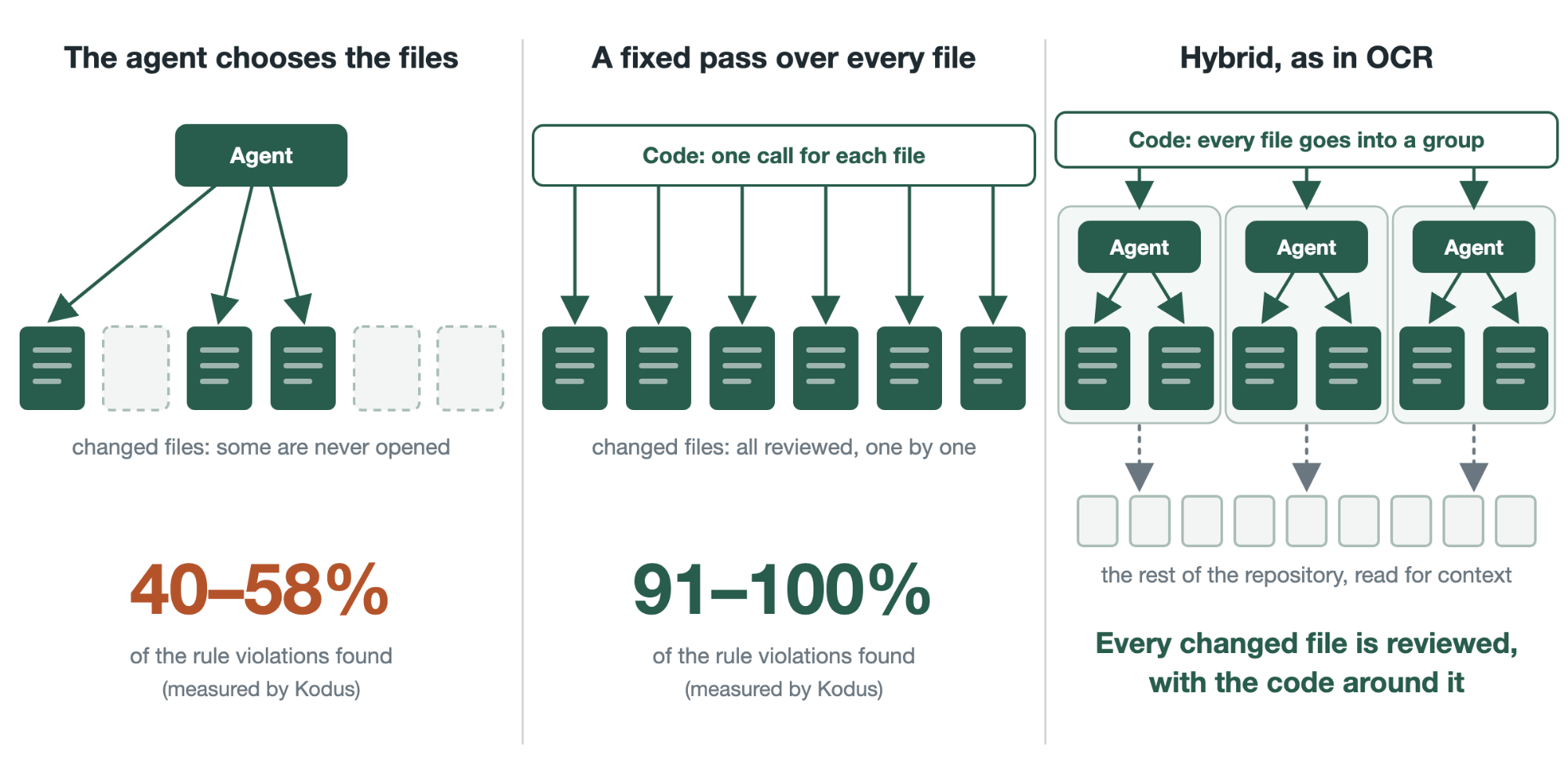
The two percentages in the figure come from Kodus, one of the twenty projects on our list, which we excluded because of its license. Kodus lets a team write its own rules for the review, such as “never log personal data”, and at first it checked them with an agent that decided by itself which files to read. When the Kodus developers measured how many violations were actually found, the answer was 40% with GPT-5.4 and 58% with Kimi, because on large pull requests the files containing the violations were often never opened, so they went back to a fixed pass, one call to the model for every changed file, and the share of violations found rose to between 91% and 100%. We did not repeat this measurement ourselves: the numbers are written in a comment in the source code of Kodus, which refers to their issue #1449, and they concern a team’s own rules rather than bugs in general, but they show well enough what happens when the agent is left to decide where to look.
How does OCR work?
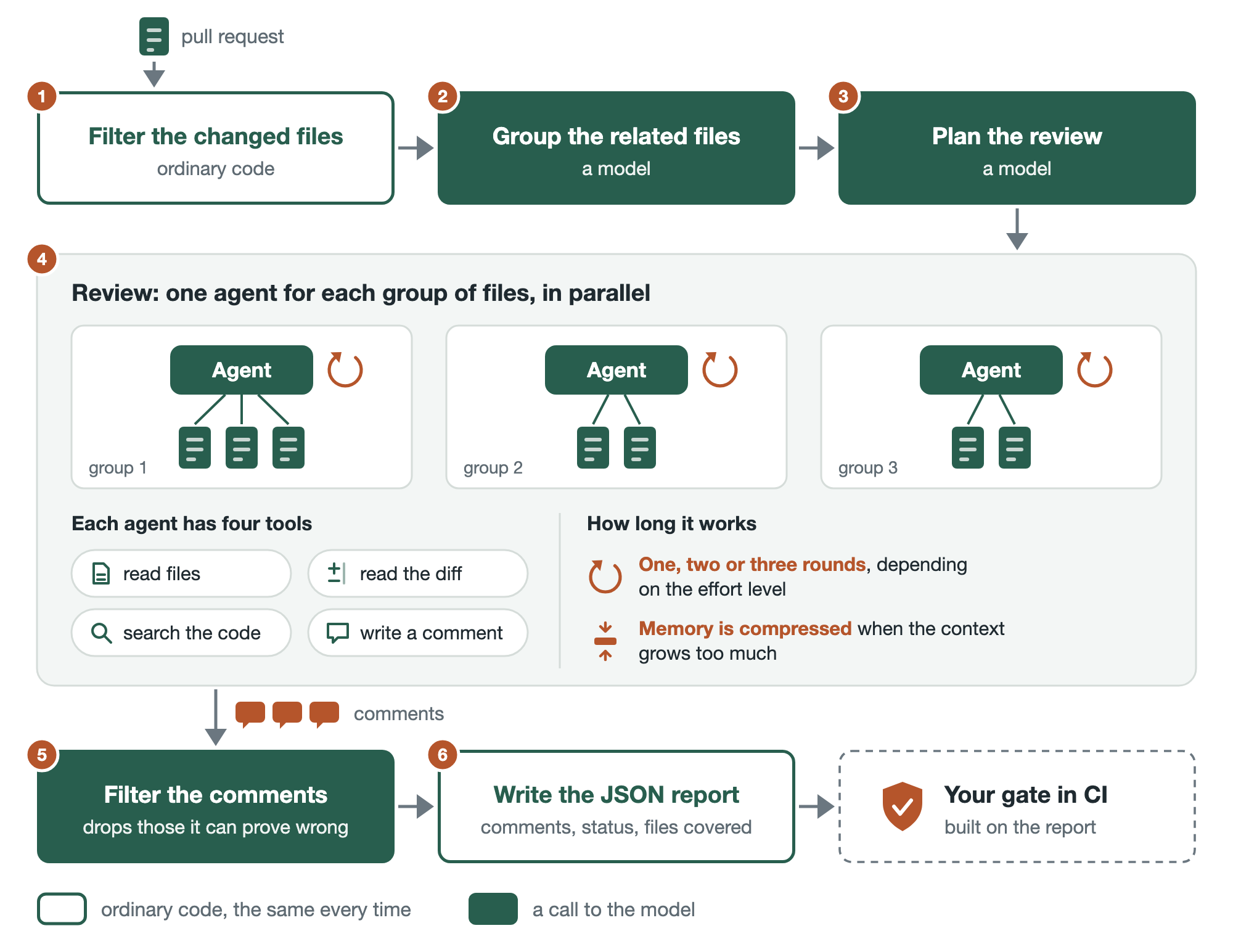
OCR is a command-line tool written in Go, released under Apache-2.0, that runs in CI. This is how it reviews a pull request:
- It filters the changed files.
- It asks a model to group the related files.
- It plans the review.
- It runs one agent for each group, with a small set of tools: reading files, reading the diff, searching the code and writing a comment.
- Depending on the effort level, the agent runs one, two or three rounds, compressing its memory when the context grows too much.
- At the end a separate step removes the comments it can prove wrong.
- It writes a JSON report with the comments, the status of the review and the list of the files it covered, which is what you need to build a gate in CI.
It is not perfect, though: the feature we care about most, a partial review that declares itself partial and blocks the merge, is being worked on upstream but has been stuck for a couple of months, and while studying the code we found that the main loop ignores the reason why a model stopped generating. We wrote about both on the issue tracker, in #1489 and #1581, and in the meantime we covered the gap with a small script of our own, which I describe below in “What We Added Around OCR”.
How Did We Test It?
We tried the system on two of our open-source projects, LionWeb JVM and Starlasu Kotlin, and built three kinds of cases from their history:
- Historical bugs. We took commits that fixed a bug, ran git blame on the lines they changed and went back to the commit that had introduced the bug, to see whether the reviewer would have caught it, had it been there at that time.
- Pull requests we believed to be clean. We picked merged pull requests whose lines were still unchanged months later and whose files had received no fixes since. These measure the noise: everything the reviewer says on them should be, in theory, unnecessary (unless we have bugs we are unaware of, of course).
- Large pull requests, between 750 and 1,250 changed lines, to see whether the reviewer still does a good job when the change is too large to be read in one go.
We had hundreds of comments to read, so we gave that job to Fable 5.2. For each case it got the diff, the comments, what we already knew about the change and a checkout of the revision under review. We asked it to check each claim against the code and record its reasoning. A real bug meant there was something to fix. A useful comment made a valid, smaller point. Noise was the sort of observation you read, nod at and do nothing about. A wrong comment made a false or misleading claim. The percentages below use Fable’s judgments.
All the models were called through Mistral, which hosts its own models but also GLM 5.3 (flash and standard) and DeepSeek V4.1 Flash. That means one key and one contract.
Why Mistral? Funny you asked, as I was going to explain that.
Why Mistral?
For the development of code we use Claude Code and Codex, while for automations we use Mistral, which gives us a good ratio between quality and price, so it was the natural candidate also for the code reviews.
Then there is the question of the guarantees on the data. Simply, some of our clients require us to use solutions not just hosted in Europe but also controlled by a European company, because under the CLOUD Act the American authorities can ask American companies for the data they hold, wherever the servers are. We are also a European company and, when it is possible, we support European businesses. Being able to try Mistral’s own model alongside GLM and DeepSeek with the same API key made that preference easy to put to the test. Mistral Large earned its place on the results.
We also looked at whether another provider could lower the costs, and we did not find anything better. DeepSeek’s own API is cheap, but the data is processed and stored in China, and its peak hours, when the price doubles, are the European mornings. GLM on American hosts costs more than Mistral Large, and the other European hosts we found do not discount cached tokens, which for this workload roughly triples the bill.
What Did We Learn About Configuring the Models?
The first round was a matrix of 27 runs, in which we combined:
- Three models, all called through Mistral: Mistral Large 4, GLM 5.3 and DeepSeek V4.1 Flash. We also tried GLM 5.3 Flash, but later and only on the small pull request of Starlasu Kotlin, where it asked for files that do not exist and used a million tokens to write a single comment, so we discarded it without running the whole matrix on it.
- Three effort levels: low, medium and high. In OCR the effort controls only the maximum number of rounds, which is one, two or three, and the rounds stop earlier if one of them adds no comments.
- Three cases:
- a commit of Starlasu Kotlin that had introduced a known bug, so that we knew what had to be found;
- a small pull request of Starlasu Kotlin with no known bugs, to measure the noise;
- a pull request of LionWeb JVM of medium size, 252 lines over two files, large enough to make OCR plan the review.
We configured OCR with a budget of 3 million tokens and a 30-minute timeout. We measured elapsed time separately, including retries. Before talking about quality I want to describe a few things we discovered along the way:
- Mistral cuts non-streaming responses at 60 seconds. A response that takes longer to generate is closed with an empty body, and OCR retries it. GLM, which reasons for a long time, was hit constantly: one review on a medium pull request took 55 minutes and needed 74 retries (not very good, if you ask me). Enabling streaming in OCR’s provider configuration and raising the per-request timeout to 900 seconds fixed the problem.
- GLM is also slow because of how much it reasons. With streaming on, the retries disappeared but the reviews still took around 25 minutes, because GLM, as served by Mistral, produced about 20 tokens per second, almost all of them reasoning. Its reasoning cannot be turned off, but it can be reduced, and with reasoning_effort: low the same review took 18 seconds. The complication is that in OCR the extra parameters sent with each request, reasoning_effort among them, are attached to a provider and not to a model, so setting it on the Mistral provider would have affected every model we call through it, Mistral Large included. What we did is to define in OCR a second, custom provider, which points to the same Mistral endpoint and uses the same API key, but has GLM as its model and its own extra parameters, in our case streaming and reasoning_effort: low. For OCR they are two different providers, while for Mistral it is the same account calling the same API, and we can define as many of them as we need, one for each combination of model and reasoning settings, which is a trick worth knowing.
What We Added Around OCR
The first change came from a review that complained about missing tests. I could see the tests right there in the pull request. OCR filters test files out of the diff it hands to the model, so we added a rule telling Mistral where to look. If coverage matters, it searches the test sources first. A confirmed gap gets a low-severity comment. We tried the rule on three PRs and the missing-test complaints disappeared. Giving the model every test diff also worked, at 1.5 to 4 times the cost.
The second change was a short Python script that reads OCR’s JSON report. We wrote it after seeing a review marked complete even though one group of files had stopped halfway. The script first checks the status, token budget, failed files and warnings about groups that stopped early. Any of those signs of an unfinished review gives us INCOMPLETE, so we can rerun it or ask someone to review the change. A completed review gets HUMAN if it has a high or critical finding, or touches a path we’ve marked for architectural review. Everything else gets READY. Take the Starlasu change with the design bug. Mistral missed the defect we knew was there, but another finding on the same change was enough to send it to a person. That’s a useful distinction when you decide whether to let the verdict block a merge.
How Much Effort Should the Reviewer Put In?
OCR has three effort levels, and its default is medium. I expected that more rounds would mean a better review, but our data says the opposite: in the first round, for every model, the share of useful comments was highest with the low effort, and the extra rounds added mostly noise and wrong comments. This is why you need to try out stuff and not just follow your instincts!
With Mistral Large the useful comments went from 50% at low, to 44% at medium, to 33% at high.
We then went back to the cases where a higher effort should have helped the most, a design bug Mistral had missed and three large pull requests, and tried medium and high there.
| Case | Effort | Cost | Bugs found | Wrong comments | Verdict |
|---|---|---|---|---|---|
| Design bug (Starlasu) | low | $0.50 | 1 | 0 | HUMAN |
| medium | $1.13 | 1 | 2 | INCOMPLETE | |
| high | $1.35 | 1 | 7 | INCOMPLETE | |
| Large PR, Starlasu #442 | low | $0.70 | 3 | 2 | HUMAN |
| medium | $1.07 | 3 | 3 | INCOMPLETE | |
| Large PR, LionWeb #457 | low | $0.27 | 0 | 2 | HUMAN |
| medium | $0.35 | review stopped halfway | INCOMPLETE | ||
| Large PR, LionWeb #454 | low | $0.21 | 0 | 0 | READY |
| medium | $0.26 | 0 | 0 | READY | |
As you can see, none of the levels found the design bug we were looking for, and I should clarify that the bug counted in the first three rows of the table is a different one, the Scope.resolve problem that I describe later in this article. What we got from the higher levels is that they cost more and they produced more wrong comments, and in one case the review did not even get to the end, because the memory compression broke on the largest file of the pull request. The other INCOMPLETE verdicts are due instead to the token budget, which we had left at its default of 3 million tokens per review, an amount that both medium and high exceeded, so with a larger budget they would have cost even more. Given all this we settled on a base configuration which is quite simple, with Mistral Large at low effort on every pull request, together with the rule about tests.
Can we get a smart solution for complex PRs?
For risky pull requests we tried something more advanced. The idea was to run GLM with reduced reasoning in parallel with Mistral, because it costs a few cents and finishes in under a minute, then pass each of its comments to a verifier, a short call to Mistral that receives the comment, the code around it and the diff of the file and answers whether the comment is correct, and finally merge the confirmed comments with Mistral’s. On the 60 comments GLM wrote on twelve cases the verifier worked well on wrong comments: it rejected 12 of the 17 that Fable had judged wrong, including all six of the wrong ones marked critical or high, and it cost 15 cents in total. Unfortunately it also rejected the only bug that GLM had found and Mistral had not, the design bug, which can only be understood by looking at several files together, while the other five bugs GLM found had already been found by Mistral. On these twelve cases, the second model did not add a single bug to the final review.
The sample is small and a single bug makes all the difference, so I would not discard the idea forever, but for now we are not adopting it: on our cases it did not add a single bug, and it would make the setup more complicated and more fragile. We will come back to it when we have more cases, especially pull requests that span several files, which is where a second opinion could make a difference.
Is It Any Good?
Here are the two comparisons in which the models saw the same changes at low OCR effort. The first three rows cover our original three cases, including one historical bug. The last two cover a second sample of twelve, including four historical bugs. “Wrong comments” counts individual comments that Fable judged wrong. Cost multiples use Mistral Large on the same sample as the baseline. For DeepSeek we have the euro amount from the console.
| Cases | Model | Known bugs found | Wrong comments | Time per review | Cost |
|---|---|---|---|---|---|
| Original 3 | Mistral Large 4 | 1 of 1 | 2 of 8 (25%) | 59 s–5 min | 1× |
| Original 3 | GLM 5.3, default reasoning | 1 of 1 | 0 of 7 (0%) | 7–19 min | about 7× |
| Original 3 | DeepSeek V4.1 Flash | 1 of 1 | 5 of 12 (42%) | 2–3 min | €0.20 total |
| Follow-up 12 | Mistral Large 4 | 3 of 4 | 3 of 64 (5%) | 57 s–5½ min | 1× |
| Follow-up 12 | GLM 5.3, reduced reasoning | 4 of 4 | 17 of 60 (28%) | 10–49 s | about 0.4× |
DeepSeek hit its token budget on the historical bug. We also tried GLM 5.3 Flash on one small PR. It spent about five minutes on the review and asked for files that didn’t exist, so we stopped there.
The twelve-case comparison is the one that settled it for me. GLM with reduced reasoning found the design bug that Mistral missed. I’d happily take that extra finding. Seventeen wrong comments in twelve reviews would wear me down pretty quickly, especially when six describe the same nonexistent file. Across the full pilot, Mistral Large found four of five historical bugs and finished every low-effort review. That’s the model I’d want looking at our next PR.
We also looked separately at the ten merged PRs we had picked as likely clean. Mistral wrote 32 comments on those. Fable counted one bug, nine useful observations, seventeen pieces of noise and five wrong comments. That gives us 5 of 32 wrong (16%) on this particular sample. Two of the five complained about missing tests, which is what prompted the rule above.
In the original seventeen-case pilot, every change with an identified bug received a HUMAN verdict. A later repeat on the LionWeb cycle-detection bug shows the limit of that result. Mistral spotted the bug again, gave it medium severity, and the script returned READY. I’d keep that example in mind when deciding which changes always deserve a second pair of eyes.
My favorite part was finding things we had missed in code we had already reviewed and merged. Across all the configurations, the reviewers surfaced seven such problems. We could trace three to later fixes in Git. For the other four, the evidence was in the source at the revision we checked. Here’s what turned up.
- LionWeb JVM #486: new ArrayDeque<>(language.dependsOn()) throws a NullPointerException when a dependency cannot be resolved, where the previous code tolerated it. It is still in the code today.
- LionWeb JVM #348: resolveLanguage looks up the generated class names by the language name, while the documentation, the constructor, the code generator and the tests all use the language ID. The mismatch was still there when we checked. The open question is which side of that contract to change.
- Starlasu Kotlin #442: the findPrinter cache is consulted before the per-node overrides, so an override can be ignored. It is still in the code today.
- Starlasu Kotlin: Scope.resolve passes to the parent scope the name already converted to lowercase, so a case-insensitive scope inside a case-sensitive one misses symbols. It is still in the code today.
- Back in Starlasu Kotlin #442, two more findings: a
!!on a constructor that can be null, and a cache of declared features that ignores whether derived features were requested. Both were fixed later by us, the first in a commit made right after the merge and the second months later, when it was reported as issue #478. The cache problem already existed before this PR. - Starlasu Kotlin #35, a pull request from 2020: a lookup that compares nodes with == instead of ===, so with two structurally equal nodes the wrong one is modified. Fixed later, in a commit whose message says “use sameness instead of equality“, which is why our selection script, looking for the word “fix”, did not see it.
I went looking for a way to spend less time on reviews and came back with four things to look at in our own code. Fair enough. Those are next on our list.
How Much Does It Cost?
On our runs, a review with Mistral Large at low effort costs between 2 and 70 cents, and a simple model fits our data well enough: about 3 cents per review plus 0.06 cents per reviewed line, with a ceiling of about 2 dollars set by the token budget. What matters the most for the bill is prompt caching, because an agentic reviewer sends the whole conversation back to the model at every turn, so the token counts look scary, but 75 to 85% of those tokens are served from the cache at a tenth of the price, and I like that.
To give an idea, DeepSeek used 50 times the tokens of Mistral Large in one case and cost only three times as much. The prices of Mistral Large and GLM are our estimates, until we confirm them on the console.
Blah, blah, blah: what does it mean for us? How much will it cost us?
To understand what this would mean for us, we collected six months of activity across all our repositories: the Strumenta and LionWeb organizations on GitHub and our self-hosted GitLab, 48 active repositories and about 160 pull requests a month. We excluded one repository that receives the output of our transpilers, because reviewing generated code makes no sense and alone it would have doubled the bill.
| Group | Pull requests per month | One review per PR | A review at every push |
|---|---|---|---|
| LionWeb (the repositories I contribute to) | 16 | about $6 a month | about $43 a month |
| Strumenta open source | 4 | about $0.50 a month | about $2 a month |
| Strumenta private projects | 138 | about $61 a month | about $245 a month |
| Total | 158 | about $67 a month | about $291 a month |
Reviewing at every push costs four to five times as much, because OCR reviews the whole pull request every time and our pull requests have on average 4.5 commits, so we will review once when the pull request is ready, plus on request. The spending also varies a lot from month to month, between 37 and 147 dollars in the last six months, following the periods of intense development, which is why a monthly spending cap on the provider is a good idea.
To make the costs more predictable we also looked at subscriptions, but they do not work for CI. Which makes me very sad. The coding plans from Z.ai, Alibaba, Kimi and MiniMax explicitly forbid automated, non-interactive use, ChatGPT and Claude subscriptions are meant for one person in their own tools, and OCR’s own documentation says its ChatGPT sign-in must not be used for shared CI. Mistral’s subscription does not help either: according to its documentation, usage from third-party tools counts against the API allowance, not the more generous Vibe one. At least Mistral’s console lets you set a monthly spending limit for the organization or for a workspace, and we will set ours around 150 dollars, enough to cover even the busiest month we observed.
For comparison, a commercial reviewer like CodeRabbit would cost between 400 and 800 dollars a month for the 17 people who opened those pull requests, counting also the contributors to our open-source projects who do not work for us. Using Claude Sonnet 5.5 or GPT-6.2 Sol in place of Mistral Large would cost about 3.5 times as much, Claude Opus 5.5 about 7 times, and the top models from both vendors 13 to 14 times.
Summary
Automated code review is a fundamental component of the way we work. It finds problems that had escaped us, like the seven real bugs in code we considered finished, it saves us work, and it removes a situation that was frustrating for everybody, the one in which we are blocked waiting for a code review while everybody has to spend half the working time reviewing code. This does not mean that we will stop reviewing code by hand: it means that we will review by hand the pull requests that need it.
Since it is so important for us, we studied the problem in depth: we evaluated the options, we measured them on our own code and we chose the best one, which today is OCR with Mistral Large at low effort, for about 67 dollars a month across all our projects.
We’ll keep comparing this setup with Olaf, our own reviewer, and rerun the cases as new models arrive.
If you want this kind of analysis to help you develop better, just let us know.

I build parsers, transpilers and languages for people whose work is too specific for off-the-shelf software. I co-founded Strumenta, in Torino.
Reply by email · I read everything.
If this was useful, there are more on the same problem.
More in Automation & specialized work
What Is Software, and Will LLMs Replace It?A legacy estate you need to understand before you commit.
See how Strumenta worksDisclosure — Strumenta is a company I co-founded.